David Zimmermann
holds a degree in Political and Social Studies from the University of Würzburg. He is currently a student research assistant at the Institute of Criminology at the University of Tübingen. His academic interests lie at the intersection of sport, political science, sociology, and criminology.
Email: david.zimmermann@guest.uni-tuebingen.de
LinkedIn: linkedin.com/in/david-f-l-zimmermann

Dr. Daniel Nölleke
Assistant professor for “Sports Journalism and Public Relations” at the Institute of Communication and Media Research at the German Sport University Cologne. His main areas of expertise include journalism studies, sports communication and mediatization theory. He is acting chair of the ECREA Temporary Working Group “Communication and Sport” and member of the editorial boards of the International Journal of Sport Communication and Communication & Sport.
Email: d.noelleke@dshs-koeln.de
LinkedIn: https://www.linkedin.com/in/daniel-nölleke-663326170

Dr. Thaya Vester
Criminologist (fields of study: sociology, law and sports science) at the University of Tübingen; main areas of research: violence and discrimination in the context of sport; also serves on various committees within organized football (in particular the German Football Association (DFB) and the Württemberg Football Association (WFV)) and acts as a scientific adviser to the International Football Association Board (IFAB)
LinkedIn: https://www.linkedin.com/in/dr-thaya-vester
Email: thaya.vester@uni-tuebingen.de
In an era in which social media has become an integral part of everyday communication, online visibility and follower counts have gained increasing importance. Many professional football players have millions of followers, with some ranking among the largest accounts worldwide. By contrast, referees’ online reach is usually significantly smaller, despite regularly becoming the focus of public attention during major sports events such as the FIFA World Cup. While this development has already attracted scholarly attention, previous research has focused almost exclusively on clubs and players, leaving referees largely overlooked. The World Cup therefore provides a unique opportunity to examine how their digital visibility develops over the course of the tournament. This article explores how the Instagram audiences of the 23 World Cup on-field referees with an Instagram account evolved in the lead-up to and throughout the tournament. In addition, it examines whether notable changes in follower counts coincided with match appointments and considers how the referees’ posting activity and content may have influenced these trends.
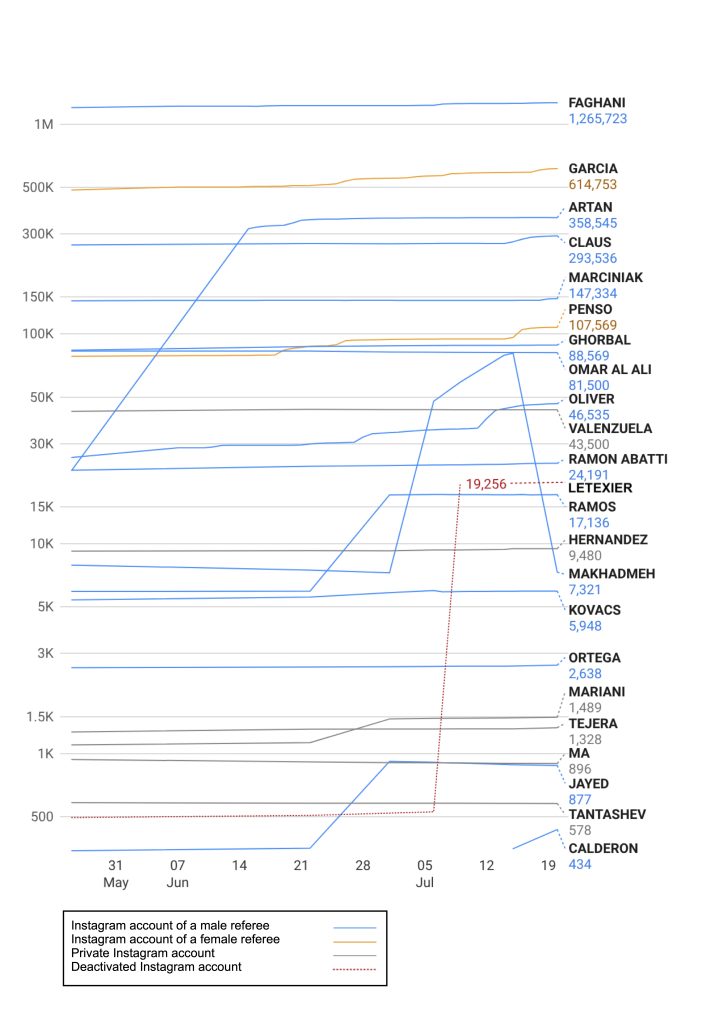
Rather than focusing solely on final follower counts, the analysis considers the trajectory of follower growth in the lead-up to and throughout the tournament. The analysis is based on the Instagram profiles of the 23 on-field referees for whom authentic accounts could be identified with certainty. The sample includes both active and inactive profiles as well as both public and private accounts. Follower counts were tracked at regular intervals from May 26th – well in advance of the tournament’s start – until July 20th 2026, the day after the World Cup final, to capture developments throughout the entire tournament. To properly contextualize the observed trends, the follower trajectories were cross-referenced with the referees’ match appointments. In addition, an analysis of account activity was conducted. Posting frequency, the amount of World Cup-related content, the frequency of other football-related posts, and the amount of personal content were each examined.
From the start of the observation period, there were significant differences in the Instagram reach of the referees included in the study. Follower counts ranged from a few hundred to more than one million, illustrating the wide range of digital visibility within the sample. The development in follower numbers throughout the tournament was also by no means uniform. While some accounts showed only marginal or virtually no changes, others experienced significant increases within short periods of time. These observed trajectories indicate that participation in the World Cup alone cannot explain the observed differences. Instead, the observed trajectories indicate that no single factor adequately explains follower development, prompting a closer examination of match appointments, media attention, and Instagram activity.
To better understand these differing trajectories, changes in follower counts were compared with referees’ respective match appointments and Instagram activity. The analysis revealed that neither the appointments nor the account activity alone could explain the observed differences. While several referees experienced significant periods of growth that coincided with their assignments, others saw only minor changes, or none at all, in their follower counts despite officiating multiple matches. Match appointments thus appear to be a relevant factor influencing digital visibility, but not the sole one.
The absence of a consistent relationship suggests that additional factors also shaped referees’ digital prominence. In addition to their on-field performances, off-field events and media attention also appear to play an important role. For example, the substantial increase in Omar Artan’s follower count coincided with international media coverage of his reported travel restriction to the United States. Likewise, François Letexier experienced a substantial increase in followers around the widely discussed Round of 16 match between Argentina and Egypt. Such examples illustrate that public attention towards referees may be driven not only by sporting events but also by media narratives, controversial matches, or viral social media content including the widely shared “After review“ meme.
Beyond these external influences, the referees’ own communication strategies may also have contributed to the observed developments. While no clear relationship was found between the total number of posts published and follower growth, it became apparent that accounts that remained active during the tournament and regularly posted tournament-related content more often experienced notable follower growth. Although the exploratory nature of this study does not permit causal conclusions, these observations suggest that active engagement with tournament-related content may increase digital visibility.
Taken together, these observations suggest that digital visibility is shaped by more than sporting performance alone. They also highlight a fundamental tension in modern refereeing. Unlike players or coaches, referees are expected to remain impartial and, ideally, inconspicuous during matches. Professional success is often associated with officiating matches without becoming the center of attention. Social media, however, follows a contrasting logic in which visibility, personal communication, and constant presence are rewarded. This places referees in a unique position, as professional success and digital visibility are not necessarily driven by the same mechanisms. The present findings therefore suggest that digital visibility among the World Cup referees is not determined by tournament participation alone but emerges from the interaction of sporting exposure, media attention, and individual communication. At the same time, the data demonstrate that digital prominence may also arise unintentionally through controversy, media attention, or viral online discussions rather than through deliberate self-presentation.