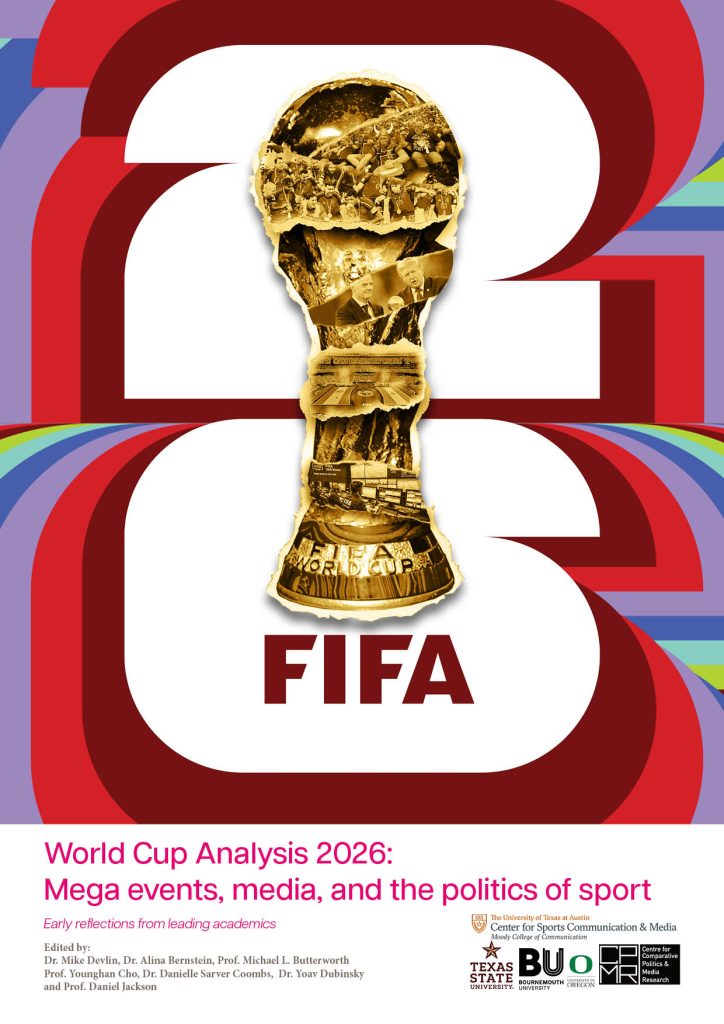
World Cup Analysis 2026:
Mega events, media, and the politics of sport
The 2026 FIFA World Cup Analysis brings together immediate reflections, research-informed commentary, and emerging insights from nearly 100 contributors at leading institutions worldwide. Published in the aftermath of the World Cup tournament, the collection offers accessible, scholarly perspectives across media and communication, marketing, sociology, political science, and related fields, while presenting new research findings and theoretical insights through the lens of sport. The report is freely available to download and may be archived in institutional repositories and library collections.
We hope it provides a vibrant, informative, and engaging account of the tournament and its wider significance.
Introduction and Acknowledgements (Dr. Mike Devlin, Dr. Alina Bernstein, Prof. Michael L. Butterworth, Prof Younghan Cho, Dr. Danielle Sarver Coombs, Dr. Yoav Dubinsky and Prof. Daniel Jackson)
Section 1: Host City & Mega-Events
- Nation branding, city diplomacy, and the 2026 FIFA World Cup: The missed opportunity Dr. Yoav Dubinsky
- Looking for America at the 2026 FIFA men’s World Cup Prof. David Rowe
- Reconsidering simplistic assessments of environmental harm Dr. Brian McCullough
- Elevating the gritty city: Philadelphia and the World Cup politics of welcome Zoe Tzanis
- The hidden price of welcome: Tipping, inequality, and mega-event hospitality Dr. Umer Hussain, Dr. Steve Bien-Aimé, Prof. Patricia Weems Gaston, and Hanbo Liu
- A Transit Hat Trick? Short-Lived Sustainability at the 2026 FIFA Men’s World Cup Dr. Courtney M. Cox and Analise Pugh
- Place and Art: Communicating Local and Global Soccer Community Dr. Anthony Cavaiani
- Infection control amid weakened public health infrastructure at World Cup 2026 Dr. Kathleen Bachynski
- What separated winners from losers in the 2026 World Cup knockouts Dr. Filipe Manuel Clemente
- The role of individual sports diplomats at the 2026 FIFA World Cup Prof. J. Simon Rofe
- The United States men’s national team has always had a problem with home Dr. Stephen P. Andon
Section 2: Global Media Coverage
- The Brazilian national team call-up: A shadow theater Dr. William Douglas de Almeida
- Images over the match: the 2026 World Cup as spectacle Dr. Shuhua Zhou
- Beyond the backlash: Online conversations surrounding the 2026 World Cup Dr. Roxane Coche and Dr. Nathan Carpenter
- The world’s coaches and the social media blame game Dr. Peter English
- Better than being where? The fragmented audience Prof. Garry Whannel
- The World Cup’s newest disruption for sports journalism is generative AI Dr. Fahad Humayun
- Ten days on Fox TV’s planet FIFA Dr. Michael Mirer
- Beyond the pitch: How The Athletic addressed the larger framework of the World Cup Dr. Xavier Ramon and Dr. Christopher D. Tulloch
- The revival of newsletters in the coverage of sports mega-events Dr. José Luis Rojas Torrijos
- “All eyes on us”: World Cup framing in Mexican and Canadian mainstream news Dr. Cecilia Arregui Olivera, Dr. Vitaly Kazakov, and Dr. Kirsten Frandsen
- Roblox and the mediatization of soccer: the case of FIFA Super Soccer Dr. Estée Fresco and Dr. Natalie Coulter
- Political framing of the World Cup in distinct media systems: the case for comparative, interdisciplinary research Dr. Kirsten Frandsen, Dr. Cecilia Arregui Olivera and Dr. Vitaly Kazakov
- From heroes to villains: how the media shaped the image of the Czech national team at the World Cup Dr. Veronika Macková and Dr. Ondřej Trunečka
- FIFA’s creator correspondents – the beginning of the end of sports journalism? Dr. Matheus Simões Mello and Dr. Thomas Horky
- The creator World Cup: How FIFA expanded engagement while controlling access Dr. Merryn Sherwood
- Oops, they did it again – from protest to criticism light Dr. Jörg-Uwe Nieland and Dr. Thomas Horky
- From training tool to broadcast innovation: Referee View at the Football World Cup 2026 Dr. Daniel Nölleke, Dr. Thaya Vester, and David Zimmermann
- Visiting “friends”? Media discourse on Europeans’ World Cup experiences in times of transatlantic frictions Dr. Karsten Senkbeil
- “No Payne, no gain”: New Zealand media sticks to traditional game plan Dr. Alida Shanks
- How the FIFA World Cup shapes referees’ Instagram visibility David Zimmermann, Dr. Daniel Nölleke, and Dr. Thaya Vester
- “Here we go!” Transfer journalism and the 2026 World Cup Dr. Thomas Birkner
- Mexican TV and its Three World Cups Dr. Sergio Varela Hernández
Section 3: Fandom
- The 2026 World Cup, the carnivalesque, and “modern football” Dr. Jan Andre Lee Ludvigsen
- Fandom and identity: Scotland Prof. Raymond Boyle
- Football and the reasons that bring us together Hilvânia Maria de Carvalho
- What are we watching when we watch the World Cup: A very American take Dr. Amy Bass
- Fanship and shifting national identities: The promise of the World Cup Dr. John M. Sloop
- EAFC and the building blocks of soccer fandom in the United States Dr. Johnathan Anderson
- “There’s always a few dickheads”: Live sites, public dis/order and the crowd as media spectacle Dr. Brett Hutchins
- “No Scotland, no party”: Framing the Tartan Army as Scottish ambassadors Dr. Richard Haynes
- No cheers for Bafana Bafana: Nigerian football fans and the politics of xenophobia Dr. Unwana Samuel Akpan and Dr. Chuka Onwumechili
- Cosmopolitan kick: Watch parties, global imaginaries, and World Cup fandom in Singapore Dr. Lou Antolihao and Luis Necias P. Antolihao
- Toward the 2026 World Cup: Transforming Indonesian soccer into a sportification of popular culture Dr. Meistra Budiasa
- Cheering for someone else’s team: Israel’s World Cup without Israel Dr. Haim Hagay and Dr. Alina Bernstein
- Cones and goings: Scotland at the World Cup Andy Harrow and Dr. Michael Higgins
- Streets in green and yellow as spaces of communitas in Brazil during FIFA World Cup Dr. Otávio Tavares and Bruno Malias Mendes
Section 4: Identity and Representation
- Access at the World Cup Dr. James L. Cherney
- A tale of two migrations: Socceroo Mo Toure and the migrant politics of the world’s game Prof. Andy Ruddock
- Come together Prof. Michael Silk and Dr. Keith Parry
- A stigmatized symbol: The St George’s Cross at the 2026 FIFA World Cup Dr. Daniel Read and Prof. Daniel Lock
- The “first” women referees breaking the norms Dr. Riikka Turtiainen
- Inherited, contested, recreated: England-Argentina as living heritage Dr. Josh Bland
- FIFA 2026 the people’s game: walking, white & wealthy Dr. Nancy Harrington
- Notes on xenophobia and the “true identity” of the Brazilian national team João Vítor Marques
- Why racist abuse of France persisted at a World Cup like no other Dr. Ondřej Trunečka
- The other side of globalization: Congolese of Belgian origins in DR Congo’s 2026 World Cup squad Dr. Guilherme Silva Pires de Freitas and Dr. Felipe Antonio Honorato
- “Amefricanidades” on the global stage: Brazil, Cape Verde, and Afro-Atlantic belonging in FIFA World Cup media narratives Dr. Doiara Silva dos Santos and Clarisse Silva Caetano
- Gender inequalities in World Cup coverage: why a recurring issue remains difficult to frame Dr. Sandy Montañola
- Finally on the road to normalization? The inclusion of female referees at the 2026 FIFA World Cup Dr. Thaya Vester, David Zimmermann, and Dr. Daniel Nölleke
- Pathway to a global platform for disability football: Paralympics, FIFA or both? Prof. Sean Tweedy, Prof. John Cairney, Prof. Sam Robertson, and Prof. Emma Beckman
- Liberté, Égalité, Mbappé: Les Bleus and America at 250 Dr. Lindsay Sarah Krasnoff
- The World Cup and the racial boundaries of the nation: Football, Whiteness and belonging in Europe Dr. Carmen Longas Luque
- The Man Who Would Be King Dr. Otávio Tavares and Sulamita Alves de Oliveira Rodrigues
Section 5: Governance, Policy, & Business
- The World Cup’s $10 billion sustainability blind spot Prof. John Davis
- FIFA captured Mexico’s World Cup, but fans took it back Dr. Mireya Márquez-Ramírez
- FIFA and the World Cup double down on growth while existing in sticky crises Dr. Karen L. Hartman
- Why CONMEBOL strengthened its reputation despite losing the World Cup Prof. Nahuel Ivan Faedo
- VAR is getting smarter — but soccer’s biggest decisions are still human Dr. Tom Webb and Joshua Gray
- FIFA as the embodiment of corrupt crony capitalism Dr. Mark Doidge
- A man for all seasons? How Gianni Infantino holds on to power Prof. Alan Tomlinson
- Fighting ambush marketing through contracts: The role of ticket terms of use and stadium codes of conduct Dr. Cem Abanazir
- Aleksander Čeferin’s imperfect campaign for an undefined presidency Dr. Simon Ličen
- The World Cup as a Marketplace of Wagers Dr. Jason Kido Lopez
- A red card for sustainability: The environmental cost of modern World Cup jerseys Dr. Susan L. Sokolowski
- Predicting the World Cup champion: Media, AI, and the illusion of algorithmic certainty Dr. Angel Torres-Toukoumidis
- Adjudicated twice: dispute resolution at the FIFA World Cup Prof. Joshua Gordon
- Online Abuse, Diversity and Representation in Match Officiating: Reflections from the 2026 FIFA World Cup Karan Rai, Prof. Daniel Kilvington and Arran Williams
Section 6: Politics
- Time to abolish the World Cup Prof. Adriana Pantoja de Alba and Dr. Toby Miller
- Colombia – Whose shirt is it anyway? Dr. Peter J. Watson
- Players and Politics: The Messi Case Dr. Pablo Alabarces
- Sportswashing and the 2026 FIFA World Cup: The politics of World Cup enjoyment Dr. Jack Black
- How mega-events help authoritarians like Putin and Trump Dr. Sven Daniel Wolfe
- How did the United States use the 2026 FIFA Men’s World Cup for political ends? Dr. Kyle R. King
- Leaving more than a jersey: the rhetorical power of the Iranian national football team’s letter Dr. Mark A. Mederson
- Football solidarity and Palestinian imagination of liberation and justice Dr. Nadia Naser-Najjab
- The Colombian National Team, Political Tensions, and National Identity Prof. Jorge Ruiz Patiño
- Palestine: The 49th Team at the 2026 World Cup Dr. Jules Boykoff
- Life without the World Cup: Football in Hungary’s political transition Dr. Tamás Dóczi and Dr. Dunja Antunovic
- The changing forms of protest at the FIFA 2026 World Cup Carole Gomez
- Setting the welcome mat on fire Dr. Katherine L. Lavelle
- More than a game: Athletes between performance and political communication Dr. Jana Wiske