
Dr. Otávio Tavares
Full Professor in the Federal University of Espírito Santo. Head of the ARETE – Centre of Olympic Studies and Sport. He teaches and conducts research on sport sociology and Olympic Studies. He is the author of four books, 67 academic papers and 51 book chapters.
Email: otavio.silva@ufes.br

Sulamita Alves de Oliveira Rodrigues
Master in Physical Education from the Graduate Program in Physical Education at the Federal University of Espírito Santo. She conducts research on sociology of sport with a special focus on eSports and Virtual Sports.
Email: Sulamita.17@hotmail.com
In a book published in 1888 titled The Man Who Would Be King, Rudyard Kipling tells the story of two former British Empire soldiers who head to Central Asia in search of adventure and riches. The story recounts how one of them, hailed as a deity by the locals, becomes a king and gains access to the unknown treasures of Alexander the Great, which had been deposited there. Blinded by the ambition and glory he has achieved, he disregards the risks until he is killed when the locals discover they have been deceived and that he is just as human as any of them.
The ending is tragic and the protagonists are foreigners, but this story came to mind when, intrigued, we began observing populations in countries on the periphery of global football who passionately root for Brazil and Argentina during the FIFA World Cup. This is especially striking because some of the most ardent fans in these nations are citizens of countries in the very region where Kipling’s story is set. What drives citizens in Karachi (Pakistan), Kerala (India), and Bangladesh as well as in Indonesia, Timor-Leste, Jamaica, and Lebanon, to wave the flags and wear the jerseys of distant nations, cheering so fervently for Messi or Neymar?
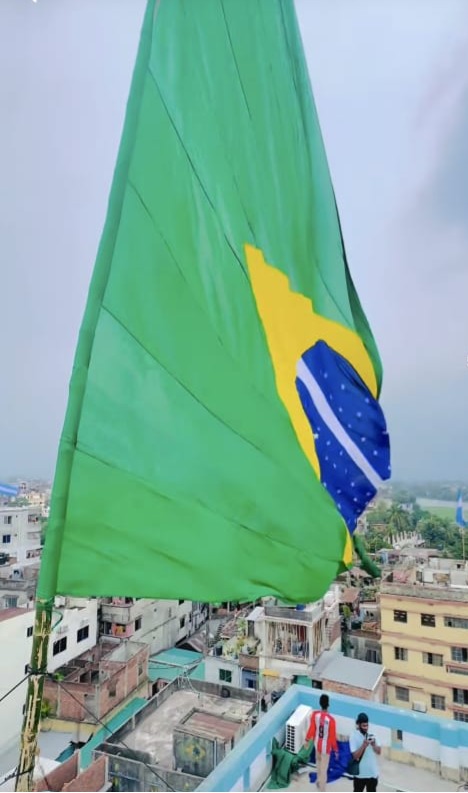
By this point in the text, you have likely noticed our view that citizens of countries with only a remote chance of making a significant mark on the World Cup seize upon an identification with football powerhouses from developing world as a way to feel like kings themselves. As the Brazilian anthropologist Roberto DaMatta taught us, the World Cup is an event in which the local encompasses the universal. Unlike the sporting diversity of the Olympic Games, which dissolves identities, the football World Cup revolving around a single globally popular sport allows for identification and direct comparison between nations and their styles. In this sense, could we speak of foreign fanbases as “(transnational) imagined communities,” in the terms of Benedict Anderson?
The idea seems as appealing as it is simplistic. Despite William of Ockham’s principle of parsimony, the identification postulate appears to be merely a general hypothesis; among fans located on the world’s periphery, there are differences in how they identify with national teams from the Global South – an umbrella term for a multitude of countries contrasted against the lingering structures of colonial power.
It is worth noting that, despite being neighbors, the overarching identities of Brazil and Argentina oscillate between a shared Latin identity and distinct ethno-cultural narratives. Although the white population in Brazil accounts for just over 45% and the number of people living in poverty has decreased significantly, in the minds of many, Brazil remains a Black, underdeveloped, tropical country. Meanwhile, our neighbors—economically “Third World” despite a glorious past—cultivate an image of whiteness and a claim to a Europeanized culture (both outwardly and internally), notwithstanding the significant Indigenous component of their population.
We can assume that the shared Portuguese language, a common colonial past, and a perceived ethnic identity may foster a sense of identification with the Brazilian national team among Angolans, Mozambicans, and Timorese. Similarly, we can assume that Haitians and Jamaicans, despite differing languages and histories, have reasons to identify with the Brazilian team, given the prevailing perception of Brazil as a Black and Third World nation. In the case of Haiti, moreover, tangible aid provided through United Nations missions likely cemented a positive image and the notion that the Brazilian people are “one of us.”
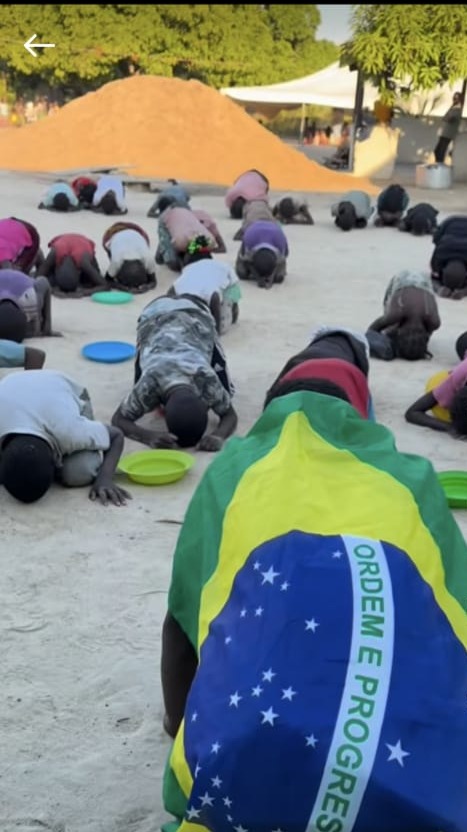
Lebanon is another country where a vibrant fan base for Brazil was found, complete with street parties, fireworks, and flags. While there is no shared language or colonial history here, the Lebanese people have a long and deep-rooted connection with Brazil. Since the 19th century, waves of people from that region have migrated to Brazil to such an extent that the population of Lebanese descent in Brazil is estimated to be larger than the population of Lebanon itself! Despite their high level of integration into local society, the enduring family ties spanning both sides of the globe and the resulting bonds of mutual sharing inevitably come to the fore at moments like these.
More challenging to understand are the bonds of identification that have formed in regions of Asian countries as diverse as Pakistan (especially Karachi), Bangladesh, India (especially Kerala), and Indonesia. How can one make sense of fanbases in countries of such immense ethnic, linguistic, and cultural diversity being so passionate about the Brazilian and Argentine national teams? Language, history, and culture offer no basis for a plausible explanation. The temptation to attribute this to similar skin color falls apart the moment one looks at a photo of the Argentine national team, leaving us with the same question.
Perhaps here we must revisit the hypothesis of an “imagined community” among people from peripheral nations, members of the Global South who view and identify with the Brazilian and Argentine national teams as offspring of a European colonial past that, at least in football, asserted a position of superiority over the countries of core capitalism. As we have seen, this transnational, imagined, and temporary community (manifesting only every four years) appears to possess structural layers and nuances. Yet, in any case, the national teams of Brazil and Argentina may, even unintentionally, offer people from such diverse corners of the globe the chance to feel like Kings, too.