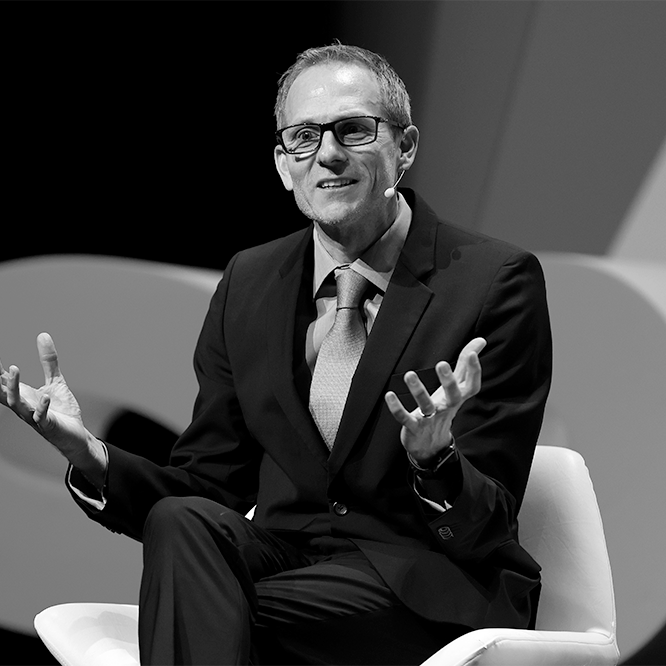
Prof. J. Simon Rofe
Professor of Sports Diplomacy and Management in the Carnegie School of Sport at Leeds Beckett University; Associate Programme Director at Wilton Park; Senior Research Fellow and Assistant Programme Director at the Institute for Sport Humanities. His work embraces practitioner engagement and he has worked with numerous stakeholders from across the sporting and diplomatic realms and is author or editor of numerous books and articles.
As the World Cup was lifted by Spain’s captain Rhodri after his team’s victory over Argentina in the FIFA Men’s World Cup final, he was on the stage with three individuals who had been on a similar stage in the same stadium—New York/New Jersey’s Metlife stadium—at the conclusion of FIFA’s first World Club Championship twelve months previously. One was the player Marc Cucurella, known for his vexatious spirit on the pitch as a member of both winning teams; the other two more prominent off the field of play, perhaps equally vexatious. They were Gianni Infantino as the President of FIFA, and Donald Trump as the President of the United States. These two individuals and the role they played leading up to and through the tournament itself has received much attention, and will continue to do so, not least in the contributions to this report.
The analysis that this piece focuses upon, is on United 2026 – the name of the bid led by the United States Soccer Federation together with the Canadian Soccer Federation and Mexican Football Federation—as a World Cup of individuals and individualism—in contrast to the victorious Spain team. It does so by drawing on the concept of sports diplomats, phrased as “ambassadors in tracksuits” by Gavin Price and Lindsay S. Krasnoff, amongst others), and as a function of wider Sports Diplomacy discourses. This article sees Sports Diplomacy as “an enabler for nations, federations, regions, teams, and individuals to demonstrate values, capabilities and opportunity, including commercial dimensions. It does so by harnessing the powers of sport to ‘Communicate, Represent and Negotiate’ across sporting and diplomatic landscapes.”
Often the most-high profile of sports diplomats is the athlete. United 26 was no exception. Despite the simple fact that football is a team sport of 11 vs 11, individuals dominated World Cup narratives and provide points of tension for understanding sports diplomats. The most noticeable, both implicitly and explicitly, were two players in the dotage of their careers: Cristiano Ronaldo and Lionel Messi. Their rivalry has been a consistent, often dominant narrative in men’s football for 15 years, stemming from their prowess on the pitch, to the explicit rivalries during their La Liga days, to their competition for Ballon D’Ors, and to their commercial contests between headline sponsors Nike and Adidas. Their individual imagery superseded their teams’ identities, leading to particular sporting outcomes. Both teams’ coaches Lional Scaloni and Roberto Martinez made significant tactical decisions to accommodate their respective star individuals, potentially at the expense of their team’s development and performance – and in Martinez’s case his job. Indeed, the narrative of “individual vs. team” was a clear feature of much of the coverage with a heightened focus on race for the Golden Boot (the competition’s highest goal scorer) and overall top scorer across World Cups, both of which pitted Messi against Kylian Mbappé, France’s talisman.
The individualization was neither reserved for players with impressive track records, nor those with significant prior marketing presence. The progress of Cape Verde’s team from their group where they held Spain to a 0-0 draw, to lose to Argentina in extra time, was shared in individual terms with a focus on their 40-year-old goalkeeper, Vozinha. With a focus on his social media presence and his mother, Cape Verde’s goalkeeper became the representative of the small island nation; even appearing—individually, of course—on CBS Mornings sharing with the audience the impact of the World Cup performance on his nation. In short, he was an ambassador for Cape Verde.
The hyper-individualism of United 26, made more possible by a technological-commercial nexus, was seen not just on the pitch and should not have been a surprise when individual enterprise has long-been cherished in U.S. society. In the stadiums, coverage of every match featured shots of high-profile individuals—often from other sports or celebrities. In marketing terms, in the stadia and beyond, individuals were highly prominent. None more so than former England Captain, and Inter-Miami President and Co-owner, David Beckham. Beckham, a marketer’s dream since his early playing days, was seemingly a highly optimized one man-marketing machine. It was possible to watch an entire “game break”—as the U.S. host broadcasters FOX and NBC framed FIFA’s newly constituted hydration breaks—of Beckham adverts back-to-back for a wide variety of companies. The multiple roles Beckham played as salesman, England fan, investor in U.S. soccer infrastructure, and others – and his wife and family – allowed for many messages to be shared simultaneously with a multitude of audiences.
The individual challenge to sports diplomacy was clear in governance terms, most obviously with Infantino and Trump. Their bromance tripping over from the award of the Peace Medal at the World Cup draw in December 2025, to Trump’s intervention with Infantino in overturning Balogun’s red card, to Trump’s paucity of attendance—he only attended one match: the final—was particular to them. The scrutiny the pair received stood in contrast to many of the dignitaries and heads of state who were present during the tournament not least cohosts, Mexican President Claudia Sheinbaum and Canadian Prime Minister, Marc Carney.
The tension between the hyper-individualism on display at United 2026 and Spain’s ultimate triumph with a team absent of dominant individuals, speaks to representing something larger than themselves. If success as a sports diplomat is being ready for the next fixture and an opponent ready to play—négociation continuelle—the sports diplomat must surely be a team player.